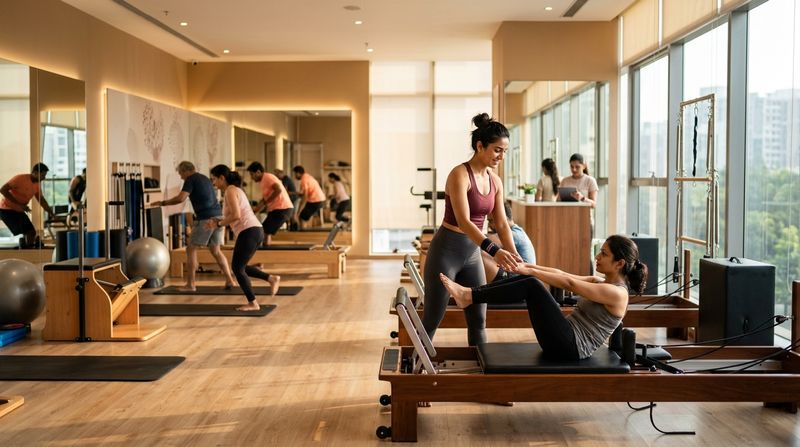
Quick answer: A Pilates franchise needs two things at once — studio software that understands reformer capacity, duets and class packs, and a head-office layer that handles royalty, brand control and network reporting. MyGymDesk covers both in one console and is built for Indian GST and rupee pricing. Mariana Tek and ABC Glofox are the strongest international options for premium multi-studio brands. Walla handles franchises well but is group-class-first. Momence is worth a look if more than half your revenue is private appointments.
We build MyGymDesk, and we're saying so up front. Where something else fits better, it's in here.
Why Pilates is not just "gym software with a different word"
A gym's capacity is the room. A Pilates studio's capacity is the equipment. Twelve reformers means twelve spots, and the day a thirteenth person books because the software counted chairs instead of machines, someone is having an awkward conversation five minutes before class.
The failure most owners discover late is subtler still: the studio's rules live in the owner's head, not in the system. "New clients do an intro session before an advanced reformer class" is a rule until the booking system lets a brand-new client straight into the advanced class.
For a franchise, that problem multiplies. Your rules have to hold in a studio you don't visit, run by an owner you don't employ, in a city you don't live in. That's the real job of Pilates franchise software: encode the brand's standards once and have them hold everywhere.
What to check before you sign anything
Equipment-level booking, per studio
Reformers, chairs, barrels and towers each cap a different class type. The system must assign specific equipment to specific slots and clients — and it must do this per studio, because your Bandra franchise has eight reformers and your Gurugram franchise has fourteen. A platform where capacity is a single global number will cost you either empty spots or angry clients.
Group, private and duet, priced differently
Most Pilates franchises sell all three. Duets in particular break systems designed for group fitness: two clients, one slot, one instructor, a price that is neither the group rate nor the private rate. If the software can't model a duet natively, your franchisees will invent workarounds, and your reporting will stop being comparable across studios.
Class packs that survive across the network
Clients buy ten-class packs and courses. Attendance draws down against remaining credits. In a franchise, the questions that matter are: can head office define the pack structure once and push it to every studio, and can a franchisee still run a local intro offer without breaking the brand pricing?
The right answer is a template push with a brand lock on the fields that must not move — name, price, duration — and freedom on the rest.
Royalty calculated from what the studio actually took
Pilates revenue is messier than a gym's: memberships, packs, privates, duets, workshops, retail. If your agreement takes a different percentage on package revenue than on retail, the software has to split collections by category and apply a different rate to each.
The version that ends arguments lets you click a fee line and see the individual payments behind it. A franchisee can dispute a number they were sent. It's much harder to dispute one they can see the receipts for.
Network reporting that compares like with like
Revenue alone tells you nothing across studios of different sizes. What you want is ARPM — average revenue per active member — beside the network average, plus collection efficiency and the expiring-versus-joining balance. Two studios on identical revenue can be in completely different health, and only those ratios show it.
The platforms, honestly
Mariana Tek — built for multi-location boutique brands, with a polished member experience across sites and enterprise reporting. Sold by quote, multi-week implementation, and you'll want someone internally who can own configuration. The right answer for a ten-plus-studio brand with a technology budget.
ABC Glofox — central brand standards, franchise templates, automated royalty handling, and bulk tools to launch a new studio on your existing setup. Custom pricing, dollar-denominated.
Walla — has a real reputation for ease of use, includes a branded app, and handles franchises and multi-location studios well. Primarily group-class focused, and the base price is high — a poor match if your studios lean heavily on privates.
Momence — worth serious consideration when more than about 60% of your business is private appointments, largely for its appointment waitlist handling.
Mindbody — the marketplace argument, not the franchise argument. If discovery through the consumer app drives a meaningful share of new clients in your market, that reach is real. In India it isn't, and you'd be paying for it.
Smaller and lighter — OfferingTree, Karmasoft, StudioGrowth and Fitli are all reasonable for an independent studio. None is built for a franchisor layer: no royalty engine, no brand lock, no per-franchisee access control.
MyGymDesk — built for premium multi-location Pilates studio brands, with a polished member experience across sites and enterprise reporting. Studio operations plus the HQ layer, built in India for the world.
Where MyGymDesk fits a Pilates franchise
Your franchisees run their own studio — their clients, their schedule, their payment gateway, their money. Head office gets a network layer on top.
It's the only India-built platform we know of that puts network reporting, licence control, royalty billing with compliant GST invoicing and one-click template rollout in a single console. The platforms that match that scope are international but pricing are very competitive.
Be honest with yourself about size
If you run two or three studios under one company, you don't need any of this — you need good multi-location studio software, and several on this list will serve you well for years.
The moment it changes is when a studio is owned by someone else. That's when separate books, brand control, royalty and access levels stop being nice-to-haves and start being the whole job.
FAQ
What's different about franchise software for a Pilates studio versus a gym?
Capacity is set by equipment rather than floor space, so booking has to work at reformer level and per studio, since franchises rarely have identical equipment counts. Revenue splits across group classes, privates, duets, packs and retail, so royalty has to be calculated per category rather than on one blended percentage.
Can head office set class pack pricing across all studios?
Yes, with the right platform. In MyGymDesk you build the pack once at head office and push it to one studio or all, with a brand lock so the name, price and duration can't be edited locally, while leaving franchisees free to run their own local promotions on everything else.
How is royalty calculated for a Pilates franchise?
From collections recorded in the franchisee's own system, split by category — memberships, packages, privates, retail — with a rate per category, plus any fixed monthly fee and marketing-fund percentage. Per-franchisee overrides handle studios on different contract terms.
Do my franchisees keep their own payments?
In MyGymDesk, yes. Each franchisee connects their own payment gateway and collections settle to their account. Head office never holds franchisee money — it raises the royalty invoice separately.
What about GST on the royalty invoice?
It's raised from the franchisor's entity to the franchisee's GSTIN at 18%, with CGST and SGST for same-state supplies and IGST across states, on a separate invoice series. Most international platforms produce a royalty statement rather than a compliant Indian tax invoice.