If you've ever tried running a CrossFit box or functional training studio using the same software that manages a traditional gym, you already know the frustration. Waitlists that don't respect capacity limits. Coach schedules that break down the moment someone takes a sick day. Members who loved your community vibe but couldn't figure out how to book tomorrow's WOD from their phone. Sound familiar?
Functional training studios are one of the fastest-growing fitness segments in India right now — from Bengaluru's tech-belt boxes to Mumbai's boutique HIIT studios and Delhi's CrossFit-affiliated communities. But the operational DNA of these facilities is genuinely different from a conventional gym. They need functional training studio management software that actually understands how a box works — not just a traditional gym platform with a "class booking" tab bolted on.
This guide walks you through every major operational challenge that CrossFit boxes and functional training studios face in India, and explains exactly how purpose-built software addresses each one. If you're opening a new box or scaling an existing one, this is the infrastructure conversation you need to have first.
Why Functional Training Studios Are Not Just "Gyms With Classes"
Walk into a traditional gym and the model is straightforward: members pay a monthly fee, they show up whenever they want, they use the equipment independently, and they leave. Your software needs to track memberships, collect fees, and maybe send a renewal reminder.
Walk into a CrossFit box or functional fitness studio and the entire model is different. Every session is coach-led. Capacity is capped — often at 10 to 20 athletes per class — because the workout of the day (WOD) demands supervision and space. Members don't just "use your gym"; they become part of a community that trains together, competes on leaderboards, and holds each other accountable.
This distinction matters enormously when choosing software. As we explored in our post on gym vs fitness center vs CrossFit box business differences, each model has fundamentally different revenue structures, cost profiles, and management needs. Getting your tech stack right for a CrossFit box means starting with that understanding — not retrofitting gym software to fit a box.
The 5 Biggest Operational Challenges for CrossFit Boxes in India
1. WOD-Based Class Scheduling With Dynamic Capacity
The WOD is the heartbeat of any CrossFit box. But programming and scheduling WODs across multiple time slots, coaches, and equipment configurations — while keeping a real-time cap on participants — is surprisingly complex.
Traditional gym scheduling tools were built for fitness classes like Zumba or yoga, where one room, one instructor, and a fixed number of mats define capacity. In a functional training studio, capacity might shift based on today's WOD. A barbell cycling workout needs more floor space than a gymnastics day. A partner WOD effectively halves your available spots.
You need class scheduling software that lets you:
When your 6 AM slot fills up and a member books the 7 AM as their second choice, your software should handle that transition seamlessly — not leave your front desk scrambling at 5:45 AM.
2. Coach Rotation and Multi-Coach Management
CrossFit boxes often run 4 to 8 coaches across morning, afternoon, and evening batches. Unlike a traditional gym where trainers work somewhat independently, box coaches rotate across all time slots, fill in for each other, and are deeply tied to class quality.
Poor coach management directly hurts member experience. If a beloved coach is suddenly reassigned and members only find out when they show up, trust erodes fast. In India's functional fitness community, word travels fast — and so does attrition.
Robust staff management within your studio software should give you:
For a deeper look at how staff pay structures affect gym operations, our guide on why Indian gym owners struggle with staff commissions covers the nuances worth understanding before you design your coach compensation model.
3. Biometric and QR Attendance in a High-Intensity Environment
In a traditional gym, attendance is relatively relaxed — members tap in and wander around for an hour. In a CrossFit box, attendance is class-specific. You need to know exactly which athletes showed up for the 6 AM WOD, not just that they entered the building sometime in the morning.
This distinction matters for safety (knowing who's on the floor if there's an emergency), for community management (tracking individual progress and consistency), and for billing (some membership tiers limit the number of sessions per week).
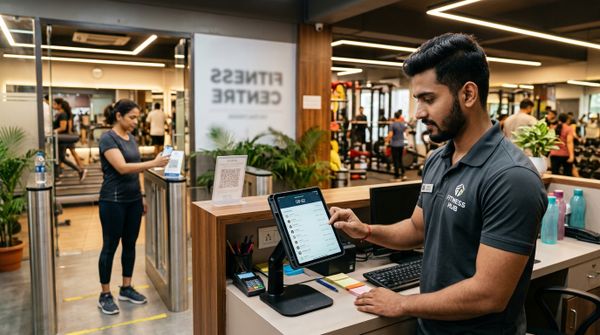
Biometric attendance or QR attendance systems solve this cleanly. When a member checks in via fingerprint or QR scan, the system logs them against the specific class they booked — not just as a general entry. Coaches can pull up the class roster instantly on their phone, mark actual attendance versus bookings, and flag any discrepancies.
For a box running 4 to 6 classes daily with 10 to 20 athletes each, this kind of precision attendance data becomes invaluable when you're trying to understand peak demand, plan coach hiring, or manage capacity expansions.
4. Community-Driven Retention That Goes Beyond Discounts
Ask any CrossFit coach what keeps members coming back, and the answer is almost never "the equipment" or "the price." It's the community. The shared suffering of a brutal WOD. The team that celebrates your first pull-up. The WhatsApp group that starts buzzing at 5:30 AM before the 6 AM batch.
But community doesn't sustain itself automatically — especially when your box grows from 30 to 150 members. You need systems that support and scale community, not replace it.
This is where a member portal and dedicated member app become essential. When members can:
…they feel more connected to the box, not less. Technology, used correctly, amplifies community rather than depersonalising it. Our guide on setting up your gym member app and portal with MyGymDesk covers exactly how to configure this experience for your members.
5. Membership Structures That Don't Fit the Mould
A traditional gym sells monthly memberships. Maybe quarterly. Maybe annual. The pricing model is simple.
CrossFit boxes and functional training studios run far more complex membership structures:
Getting these structures right — and then automating renewals, tracking session counts, and flagging when a member is close to their monthly limit — requires billing and invoicing software that handles complexity without creating complexity for your front desk team.
For a deeper dive on structuring memberships profitably, how to create a gym membership structure that sells is an excellent companion read.
How Functional Training Studio Management Software Addresses Each Challenge
Let's move from problems to solutions. Here's what purpose-built functional training studio management software should actually do for your CrossFit box.
Smart Class Scheduling Built for WOD-Style Coaching
MyGymDesk's class scheduling module allows you to configure every class slot with its own capacity limit, coach assignment, and booking rules. You can set up recurring WOD time slots, adjust capacity for specific days, and manage waitlists automatically. When a member cancels, the next person on the waitlist gets an instant notification — no manual intervention needed.
Coaches receive their upcoming schedule on their mobile app, can view the class roster, and mark attendance in real time. For a box running multiple batches daily, this kind of clarity eliminates the chaotic morning messages and missed confirmations that plague manually managed boxes.
Automated Member Communication That Builds Community
One of the most underrated tools for CrossFit box retention is timely, relevant communication. When members get a WhatsApp message the evening before with tomorrow's WOD teaser, a reminder about their booked class, or a congratulations message on their 100th session — that's not spam. That's the kind of communication that makes members feel seen.
WhatsApp automation within your studio software can trigger these messages automatically based on real events — bookings confirmed, renewals due, milestones hit. The difference between a box that feels like a community and one that feels like a business often comes down to how consistently and personally you communicate. Automation makes that consistency effortless. Our complete guide to WhatsApp automation for gyms walks through practical use cases worth exploring.
Membership Management Flexible Enough for Box Models
MyGymDesk's member management platform supports multiple membership tiers simultaneously. You can configure a ₹5,000/month unlimited plan alongside a ₹3,500/month 3x-weekly plan, a ₹800 drop-in option, and a ₹8,000 Foundations course — all running in parallel, with automatic session tracking for capped plans.
When a member on a 3x-weekly plan tries to book a fourth class in the same week, the system can flag it or charge a drop-in fee automatically — no manual policing by your front desk required.
Revenue Visibility and Business Intelligence
Growing a box requires data. Which time slots are consistently under-booked? Which coach's classes have the highest member retention rate? What percentage of Foundations graduates convert to paid memberships?
MyGymDesk's AI Business Pack surfaces these insights automatically, giving you the business intelligence to make smarter decisions about scheduling, hiring, and programming — without spending hours in spreadsheets.
Actionable Tips to Optimise Your CrossFit Box Operations Right Now
Whether you're setting up new software or optimising what you already have, here are immediate steps you can take:
Planning a New CrossFit Box? Start With the Numbers
If you're in the planning phase of opening a functional training studio in India, getting your financial model right from day one is critical. Use the gym space and capacity planner to calculate how many athletes your floor plan can accommodate per class across different WOD types. Pair that with the gym membership pricing calculator to model different membership tier structures and find the price points that make your box financially sustainable.
For a broader look at the India fitness market context, India gym industry growth stats and trends 2026 provides useful benchmarks on the functional fitness segment's trajectory — especially relevant if you're pitching investors or planning a multi-location rollout.
The India Opportunity for Functional Training Studios
India's functional fitness segment is growing at a pace that outstrips the traditional gym market. Tier 1 cities are already seeing box saturation in premium micro-markets, but Tier 2 cities — Pune, Kochi, Jaipur, Chandigarh, Coimbatore — are still in early adoption. The window to establish a well-run, community-driven CrossFit box with strong operational infrastructure is very much open.
But "well-run" is the operative phrase. The boxes that win in this market aren't necessarily the ones with the best programming — they're the ones that back great coaching with operations that don't leak members, revenue, or coach time. That's what the right functional training studio management software delivers.
Conclusion: Build Your Box on a Foundation That Scales
Running a CrossFit box or functional training studio in India is genuinely exciting — and genuinely demanding. The community you build, the transformations you enable, and the culture you create are irreplaceable. But they need infrastructure to scale. WOD-based class scheduling, precise attendance tracking, flexible membership management, and community-building automation aren't nice-to-haves for a box — they're operational necessities.
MyGymDesk's CrossFit box management solution is built with these realities in mind — from class scheduling and biometric attendance to member apps and WhatsApp automation. It's functional training studio management software that understands what makes a box different, and supports those differences rather than fighting them.
Ready to see it in action? Book a free demo with our team, and we'll walk you through exactly how MyGymDesk works for CrossFit boxes and functional training studios — including your specific scheduling structure, membership tiers, and community communication needs. Or start your free trial today and experience the difference purpose-built software makes.