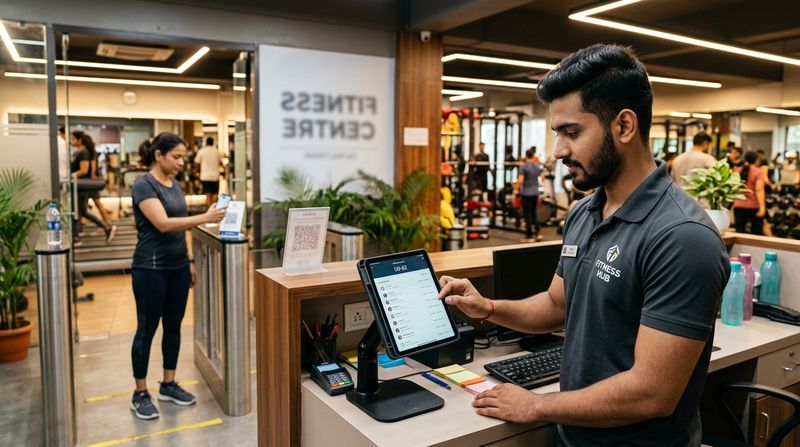
Ever wonder why your gym feels busy yet your numbers at the end of the month don't add up? You've got members walking in, trainers running sessions, and a reception desk that's always occupied — yet revenue seems to quietly slip through your fingers. The culprit, more often than not, is gym attendance tracking problems in India that most gym owners don't even know they have.
This isn't a rare problem. Across tier-1 and tier-2 cities — from Pune's Shivaji Nagar to Coimbatore's RS Puram — thousands of gym owners are running their attendance on paper registers, WhatsApp ticks, or a basic Excel sheet someone updates every few days. It feels manageable. Until you do the maths.
In this post, we'll walk through the five most common ways manual attendance creates revenue and operational blind spots, and then show you exactly how digital solutions — QR codes, biometric integration, and smart gym software — can close those gaps permanently.
Why Manual Attendance Still Dominates Indian Gyms
Before we get into the problems, it's worth understanding why so many gyms haven't made the switch yet. For a gym owner who opened with ₹15–20 lakh in investment, spending money on technology feels like a low priority when you're focused on rent, equipment EMIs, and trainer salaries.
A paper register costs nothing. An Excel sheet takes ten minutes to set up. And as long as a staff member is at the front desk, it seems like attendance is being tracked. The problem is that "seeming" and "actually tracking" are two very different things — and the gap between them is where your revenue disappears.
If you want to understand your gym's full financial picture, including where costs and losses accumulate, tools like the gym revenue and ROI calculator can give you a sobering baseline before you even start fixing attendance.
Problem 1: Ghost Members Being Billed Without Visiting
This is the most ironic revenue leak — members who haven't visited in months but are still being auto-renewed because no one cross-references attendance with billing.
Wait, you might say, isn't that good for revenue? Not really. Ghost billing leads to chargebacks, angry calls when members notice, and — worst of all — damaged reputation. A member who realises they were charged for three months while their account shows zero visits is unlikely to renew. They're also unlikely to recommend you.
In a manual system, nobody is running that report. There's no system linking your paper register to your billing cycle. With a connected platform like MyGymDesk, your member management module flags members who haven't checked in recently, letting you send a re-engagement nudge before their next billing date — turning a potential churn case into a retention win.
Problem 2: Trainers Logging Phantom PT Sessions
Personal training is one of the highest-margin revenue streams at any gym. At ₹500–₹1,500 per session, PT packages can represent 30–40% of a mid-sized gym's monthly income. Which makes trainer accountability absolutely critical.
In a manual system, PT session logs are typically maintained by the trainer themselves — in a notebook, on a shared sheet, or simply reported verbally to the admin. The problem? There's no independent verification. A trainer who completes 18 sessions but logs 20 is costing you two sessions worth of member credits. Multiply that across four trainers over twelve months, and you're potentially writing off ₹1.5–2 lakh in phantom sessions.
This is a specific form of gym revenue leakage that gym trainer productivity tracking experts consistently flag as one of the most underreported problems in Indian fitness businesses. Digital attendance that cross-references trainer clock-in, client check-in, and session logs simultaneously makes phantom logging virtually impossible.
Problem 3: No-Shows Eating Into Class Capacity Revenue
Group classes are a capacity game. If your Zumba batch has 20 spots and only 12 people show up, those 8 empty spots represent either missed upsell opportunities or — if you're running a class-cap membership model — real revenue that evaporated.
In a manual system, no-show data is rarely captured at all. Nobody writes down "Priya didn't come today" in the register. So the gym owner never knows which members are habitually missing sessions, which classes consistently underperform, and which time slots need to be restructured or replaced.
Digital attendance, especially through QR-based check-ins, creates an automatic record of every class, every slot, and every absence. You can then use that data to do exactly what we covered in reducing no-shows in gym group classes — send reminders, waitlist members, and fill empty spots proactively.
Problem 4: Staff Attendance Fraud and Salary Overpayment
This one is uncomfortable to talk about, but it's real. In gyms without digital time-tracking, staff attendance is often self-reported or tracked by a colleague — neither of which is reliable. A trainer who comes in 45 minutes late every day but marks full attendance is effectively receiving salary for time not worked.
For a gym employing six to eight staff members at salaries ranging from ₹12,000 to ₹30,000 per month, even a 10% attendance discrepancy can mean ₹15,000–₹25,000 in monthly overpayment. That's ₹1.8–3 lakh a year — enough to fund a serious equipment upgrade or a full marketing campaign.
This is a direct payroll problem, and it connects tightly to gym payroll compliance in India. When attendance data feeds directly into your payroll module — as it does in MyGymDesk's integrated system — the calculation becomes automatic and accurate. No disputes. No guesswork. No overpayment.
The staff management module, when paired with biometric or QR attendance, gives you a clean audit trail: who came in, at what time, for how long. It's also the foundation for fair performance reviews and incentive structures.
Problem 5: No Visibility Into Peak vs. Off-Peak Patterns
Revenue leakage isn't always about fraud or errors. Sometimes it's about operating blind. If you don't know when your members are coming, you can't make smart decisions about staffing, class scheduling, or equipment deployment.
Manual registers don't generate reports. They generate pages. Someone has to physically count, tally, and interpret them — and in the day-to-day chaos of running a gym, that almost never happens. So you end up over-staffing on quiet Tuesday mornings and under-staffing on Saturday evenings when the floor is chaos.
Digital attendance platforms aggregate this data automatically. MyGymDesk's biometric attendance and QR attendance systems log every check-in with a timestamp, giving you heatmaps of your busiest and quietest hours. That data directly informs decisions you're covered in posts like 7 ways Indian gyms can boost off-peak attendance — where the first step is always knowing when your off-peak actually is.
Biometric vs. Paper Register: A Before-and-After Comparison
Let's make this concrete. Here's what a typical Indian gym's attendance workflow looks like before and after switching to digital tracking:
Before (Paper Register / Excel):
After (Biometric + QR Attendance with MyGymDesk):
The operational difference is enormous. But the financial difference is what really matters — and it's consistently in the range of ₹20,000–₹80,000 per month for a mid-sized gym of 200–400 members, once all the leakage points are closed.
How to Identify If Your Gym Has These Problems
You don't need to overhaul everything overnight. Start with these diagnostic questions:
If you answered "no" or "I'm not sure" to three or more of these, manual attendance tracking is almost certainly costing you money every single month.
Use the gym member retention and churn calculator to understand how member inactivity is affecting your revenue specifically — it's a good starting point for quantifying the problem before you solve it.
Practical Steps to Fix Gym Attendance Tracking Problems in India
Here's a straightforward action plan:
For gyms just starting to build their operational foundation, the gym business plan generator is a useful resource that includes operational structure — attendance systems are part of a robust gym business plan from day one.
The Bigger Picture: Attendance Data as a Growth Tool
Fixing gym attendance tracking problems in India isn't just about plugging revenue leaks — it's about building the data foundation that drives smarter decisions across your entire business.
When you know who's coming, when they're coming, and how often, you can personalise your communication, optimise your class schedule, incentivise loyal members, and identify at-risk members before they churn. That's the difference between running a gym reactively and running it strategically.
Platforms like MyGymDesk's gym management software are built around this philosophy — connecting attendance, billing, member engagement, and staff management into one system so that every data point you collect works harder for your business.
Start Closing the Gaps Today
If your gym is still running on a paper register or a patched-together Excel sheet, every day you wait is another day of invisible losses. The good news is that switching to digital attendance is far more affordable and straightforward than most gym owners expect — and the return on investment typically appears within the first month.
Book a free demo with MyGymDesk to see exactly how biometric and QR attendance work in practice, how they integrate with your billing and payroll, and what your gym's attendance data could look like 30 days from now. You might be surprised by what you've been missing.