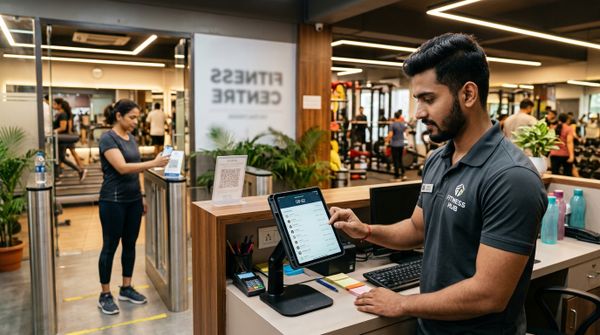
Did you know that most first-time gym owners in India discover their payroll compliance gaps only when they receive a notice from the EPFO or ESIC — often months after the violations began? If you're running a gym with even three or four full-time employees, Indian labour law already applies to you in ways that go well beyond simply transferring salaries on the first of the month.
Gym payroll compliance in India is one of those topics that nobody teaches you before you open your doors. Between Provident Fund (PF) deductions, Employee State Insurance (ESI) contributions, TDS on trainer commissions, professional tax, and the ritual of generating proper pay slips — the compliance checklist can feel overwhelming. The good news? Once you understand the basics, the monthly process becomes straightforward, especially with the right tools in place.
This beginner's guide is written specifically for gym owners managing between 3 and 20 staff members — trainers, front desk executives, housekeeping staff, and part-time coaches. We'll cover who is liable, how numbers are calculated, what records you must maintain, and how modern gym staff management software can take most of this off your plate.
Why Gym Payroll Compliance Matters More Than You Think
Many gym owners treat payroll as a simple accounting task: calculate hours worked, transfer salaries, done. But Indian labour law has specific obligations that kick in the moment you cross certain employee thresholds — and the penalties for non-compliance are steep.
Here's what's at stake:
Beyond legal risk, compliant payroll directly affects staff trust and retention. Our earlier post on gym staff turnover and the true cost of attrition found that trainers who feel financially secure — seeing their PF being deposited, receiving proper pay slips — are significantly less likely to jump to a competitor gym.
Understanding PF (Provident Fund) for Gym Staff
The Employees' Provident Fund (EPF) is mandatory for every establishment with 20 or more employees. However, once you cross that threshold, it applies to all your employees — not just the ones above a wage limit.
Key numbers to know:
Practical example for a mid-size gym in Pune:
Suppose you have a head trainer with a basic salary of ₹18,000 per month. Since they earn above ₹15,000, PF contribution is calculated on a capped basic of ₹15,000 (unless both parties agree to contribute on the actual basic).
Multiply this across 8–10 trainers and you're looking at a significant monthly obligation that needs to be remitted to the EPFO portal by the 15th of the following month.
What if you have fewer than 20 employees? You can voluntarily register under EPF, which many gyms in metro cities do to attract quality staff. Regardless of your employee count, if you have even one employee who was previously covered under EPF at another organisation, you are legally required to extend that coverage.
ESI (Employee State Insurance): Who Is Covered at Your Gym?
ESI applies to establishments with 10 or more employees (in most states) where employees earn up to ₹21,000 per month (gross salary). For employees with disabilities, the limit is ₹25,000.
Contribution rates (as of 2026):
Practical example for a gym in Bengaluru:
A front desk executive earning ₹16,000 per month gross:
ESI contributions must be remitted by the 15th of the following month. Employees covered under ESI get access to medical care, maternity benefits, and disability coverage through ESIC dispensaries — a real benefit that you can highlight during staff recruitment.
Who at your gym is typically NOT covered under ESI?
TDS on Trainer Salaries and Commission Pay
This is where gym payroll in India gets genuinely tricky. Many gyms structure trainer compensation as a combination of a fixed retainer plus commission on memberships they sell or personal training sessions they conduct. The tax treatment differs depending on how the trainer is classified.
Salaried Trainers
If a trainer is on your payroll (receives a fixed monthly salary, works fixed hours, uses your equipment, follows your schedule), they are employees and their income is taxed under Section 192 — TDS on salary. You deduct TDS based on their estimated annual income after standard deductions, and deposit it by the 7th of the following month.
Commission-Based or Contract Trainers
If a trainer works for multiple gyms or clients, issues invoices, and is genuinely independent, payments to them are professional fees — and TDS is deducted under Section 194J at 10% when annual payments exceed ₹30,000.
The grey zone: Many gyms call their trainers "freelancers" but control their schedules, assign them members, and set their rates. This arrangement may be reclassified as an employer-employee relationship during a tax or labour audit, exposing you to back-dated PF, ESI, and TDS liabilities. If a trainer works exclusively for your gym and follows your operational rules, keep them on payroll.
Professional Tax: The State-Level Obligation
Professional Tax (PT) is a state-level levy on salaried individuals and is not applicable in all states. It is applicable in Maharashtra, Karnataka, West Bengal, Tamil Nadu, Andhra Pradesh, Telangana, Gujarat, and several others — but not in Delhi, Rajasthan, Haryana, or Uttar Pradesh.
The maximum PT liability is ₹2,500 per year per employee. In Maharashtra, for example:
As an employer, you deduct PT from employee salaries, remit it to the state government, and file returns (frequency varies by state). You also pay Employer Professional Tax (PTEC) for your own business registration.
If you run a gym in Mumbai, Pune, Bengaluru, or Chennai, PT compliance is non-negotiable.
How to Structure a Compliant Gym Pay Slip
Every employee is entitled to a pay slip under the Payment of Wages Act and most state-specific shops and establishments acts. A proper pay slip for gym staff should include:
Many gyms still generate pay slips in Excel and email them manually — which works, but creates version control problems and audit risks. A structured payroll management system generates compliant pay slips automatically, with the correct statutory deductions pre-calculated each month.
Maintaining Payroll Records: What the Law Requires
Under various labour laws — the Payment of Wages Act, EPF Act, ESI Act, and the Code on Wages (which is being phased in progressively) — you are required to maintain the following records:
How long must you keep these records? Generally, a minimum of five years is recommended across most acts. For TDS and income tax purposes, maintain records for at least seven years.
A practical tip: Link your payroll records to your attendance data. If you're already using biometric attendance tracking at your gym, that data can directly feed into salary calculations — eliminating manual errors on loss of pay (LOP) days and overtime.
Commission Structures for Trainers: Getting the Math Right
One of the most common gym payroll compliance mistakes is failing to account for commission payments correctly in monthly pay slips. Here's a simple structure many mid-size gyms use:
Example: Trainer at a gym in Hyderabad
Total gross pay for June: ₹16,500
Now, for PF purposes — commission is part of gross wages and may be included in PF calculations depending on whether it is regular and certain. If commission is variable and non-uniform, EPFO guidelines allow it to be excluded from basic wage for PF calculation, but this must be documented clearly in the employment contract.
For ESI, since this trainer now earns ₹16,500 gross (below ₹21,000), ESI still applies. Both the fixed and variable components count toward gross wages for ESI.
Getting these calculations right every month is genuinely difficult to do manually — especially when you have 10–15 trainers each with different commission structures. This is exactly where gym management software with integrated payroll earns its keep.
How Payroll Software Simplifies Monthly Compliance
Let's be honest: processing payroll for 10 staff members with a mix of fixed salaries, commissions, PF deductions, ESI, professional tax, and TDS — and doing it correctly every single month — is not something a spreadsheet handles gracefully.
Here's what a modern payroll system automates for gym owners:
MyGymDesk's staff management features are designed with exactly this workflow in mind — keeping your operational data (attendance, roles, schedules) connected to your payroll process, so nothing falls through the cracks. Combined with the gym staff salary calculator, you can also model your total payroll costs before hiring your next trainer.
Actionable Checklist: Getting Gym Payroll Compliance Right
Here's what you should do — or audit — starting this month:
For a broader view of your gym's regulatory obligations — beyond just payroll — the gym licence and compliance checklist is a helpful free resource to bookmark.
Conclusion: Compliance Is a Competitive Advantage
Gym payroll compliance in India isn't just about avoiding penalties. When your trainers see their PF being deposited consistently, when they receive clean pay slips every month, and when they know their ESI coverage is active — they trust you as an employer. That trust translates directly into lower staff turnover and a more stable operation.
If you're currently managing payroll on spreadsheets and feeling the strain, you don't have to overhaul everything overnight. Start by auditing your current setup against the checklist above, formalise your trainer contracts, and explore how a connected platform — one that links your staff management and payroll in a single system — can save you hours every month while keeping you on the right side of the law.
Ready to streamline how you manage your gym's staff and payroll? Book a free MyGymDesk demo and see how gym owners across India are running compliant, automated payroll processes — without the monthly stress.