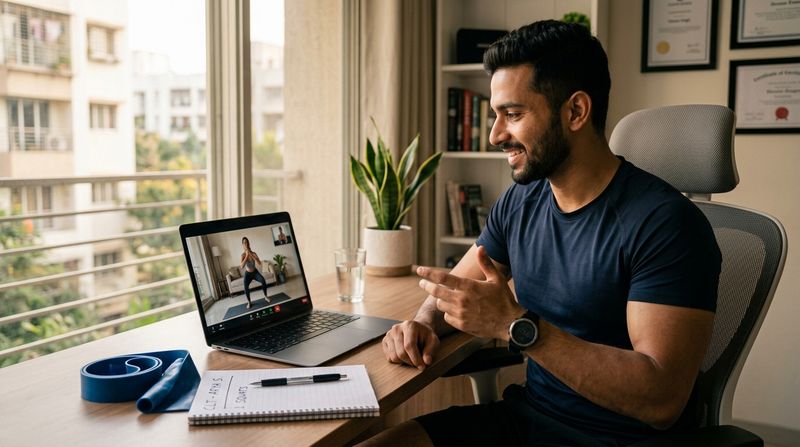
Is Your Training Business Limited by Geography?
Picture this: Ravi, a certified personal trainer in Pune, has a fully booked schedule at a mid-size gym. He's good at his job — clients get results, renewals are solid, and his weekends are packed. But his income is capped by the number of hours in a day and the size of the city he lives in.
Then a former client relocates to Bengaluru. Rather than losing the relationship, Ravi starts coaching her remotely over WhatsApp video calls and a shared Google Sheet. Within three months, word spreads. He picks up four more remote clients — two in Mumbai, one in Dubai, one in Singapore. His income jumps 40% without any additional gym floor time.
That's the quiet revolution happening across online personal training in India right now. It isn't just a pandemic-era workaround anymore. It's a legitimate, scalable business model — and Indian trainers who understand the structure are building practices that outlast trends.
Who Is Online Personal Training Actually For?
Not every trainer is suited to the online model, and that's fine. Before you invest time building the infrastructure, be honest about whether this fits your working style.
Online PT works well for you if:
It's harder if:
The Indian market also has a specific advantage: a massive diaspora and a large mobile, urban professional class who travel constantly between cities. These are your natural remote clients. They already live on their phones. They're used to paying for digital services. They want results but cannot commit to a fixed gym location. You're solving a real problem for them.
Choosing Your Niche Before You Go Online
This is where most trainers skip ahead and pay for it later. Posting "I do online fitness coaching" on Instagram is the equivalent of opening a restaurant with no menu. You'll attract nobody specific.
The niches that are working particularly well in online PT business in India right now:
Pick one. Build your content, your testimonials, and your onboarding process around that one person. You can always expand later.
Structuring Your Online PT Sessions
The biggest operational question trainers ask is: what does a session actually look like when you're remote?
The honest answer is that virtual personal training sessions look different depending on whether they're synchronous (live video call) or asynchronous (pre-programmed with video check-ins).
Live video sessions (60 minutes):
This works well for beginners who need more hand-holding and for premium-tier clients. For setup tips on managing live video sessions effectively, the guide on how to set up online yoga classes on Zoom is directly applicable to personal trainers — the tech stack is identical.
Asynchronous coaching (the scalable model):
The asynchronous model is what allows you to serve 30-40 clients without burning out. It does require you to build strong systems — which is where software becomes non-negotiable.
Onboarding Clients the Right Way
Poor onboarding is the single biggest reason remote clients quit before they see results. If the first two weeks feel chaotic — unclear expectations, delayed responses, no structure — they'll ghost you.
A clean onboarding sequence looks like this:
Week 0 (Before Day 1):
Day 1:
For the programme and diet planning side, features like diet and workout plan management inside a gym management platform let you create, assign, and update client programmes in one place — far cleaner than emailing PDFs that get buried.
One thing that separates good online trainers from great ones: communication cadence. Tell clients upfront exactly when they'll hear from you. "I review check-ins Tuesday and Thursday. You'll have my response within 24 hours." Predictability builds trust. Ghosting — even if unintentional — kills retention.
Pricing Your Online PT Packages
Indian trainers consistently underprice their online services. The offline benchmark is broken here — don't anchor to what you charge per session at a gym.
Suggested pricing tiers for remote coaching india market (2026):
| Package | What's Included | Monthly Pricing |
|---|---|---|
| Starter | Programme only, no live calls | ₹3,000 – ₹5,000/month |
| Standard | Programme + 2 live check-ins | ₹6,000 – ₹10,000/month |
| Premium | Daily messaging + weekly call + nutrition coaching | ₹12,000 – ₹20,000+/month |
NRI clients and senior corporate professionals will often pay at the top of these ranges without hesitation if the value is clear.
Always sell in packages, not per session. Single-session pricing creates the wrong psychology — clients start calculating value per call rather than value per result. A 3-month package anchors the relationship to outcomes, which is where you actually compete.
For guidance on structuring your pricing model, the gym membership pricing guide for India covers pricing psychology principles that apply equally to personal training packages.
The Technology Stack You Actually Need
You don't need an expensive custom app on day one. Here's the lean stack that works:
The key principle: every manual step you remove from your workflow is time you reinvest in coaching quality. Trainers who are still manually tracking payments, sending individual reminder messages, and emailing PDFs are the ones who plateau at 10 clients. The ones using integrated software scale past 30.
What Keeps Clients Past Month Three
Month three is the danger zone in online PT retention. The novelty has worn off. The initial weight loss or strength gains have slowed. Life gets busy. This is where most online coaching relationships break down — and where your systems need to be strongest.
What keeps clients:
For a deeper look at the principles behind keeping clients engaged, member retention and churn patterns offer useful frameworks that translate directly to solo coaching businesses.
Building Your Online Presence as an Indian Trainer
You don't need to be a full-time content creator, but you do need a digital footprint. At minimum:
One underused strategy for Indian trainers: LinkedIn. The corporate weight-loss and executive wellness niches live there. A consistent presence among IT professionals in Hyderabad or finance professionals in Mumbai can fill your calendar faster than Instagram ever will.
Actionable Steps to Launch Your Online PT Business This Month
If you're already running a gym or studio alongside your online practice, explore how personal training management software can bring your in-person and remote clients into one unified system.
Build the Business, Not Just the Side Hustle
Online personal training in India has crossed the tipping point. Clients are comfortable paying for remote coaching. The technology is accessible. The income ceiling is far higher than anything a gym floor can offer — because geography is no longer a constraint.
The trainers who succeed long-term aren't necessarily the most qualified in the room. They're the ones with the best systems, the clearest niche, and the discipline to communicate consistently even when clients go quiet.
If you're ready to build the infrastructure that supports a serious online PT business — from client management and programme delivery to automated billing — start your free trial with MyGymDesk and see how much time you get back when the admin runs itself.