For most gym apps and fitness websites, a downloaded exercise video library costs less and gives you more control than a hosted exercise API. An exercise API is a subscription: you pay every month, each request or video play counts against a monthly quota, and the videos stream from the provider's servers. An exercise video library is bought once: you host the files yourself, nothing meters your members' plays, and the videos keep working for as long as your app does. Our top pick is the Trainaq Exercise Video Library, made by the team behind MyGymDesk.
This guide compares the two models on cost, quotas, offline playback and licensing. It then works through a three-year cost example, gives you a checklist for choosing exercise videos, and sets out the steps to put the videos into your own gym app or website.
What is the difference between an exercise API and an exercise video library?
An exercise API rents you access to exercises and their media, one request at a time, for as long as you subscribe. An exercise video library sells you the video files and the data that describes them, once, under a licence you keep. The rest of the differences follow from that.
| Question | Hosted exercise API | Trainaq Exercise Video Library |
|---|---|---|
| How you pay | A subscription, every month (or a year ahead) | Once per plan |
| What you receive | Access through an API key | MP4 files and a JSON and CSV data file you keep |
| Where the videos live | The provider's servers and network | Your own app, storage or CDN |
| Usage quota | Calls or video minutes per month | None: nothing calls Trainaq's servers |
| Offline playback | Depends on the plan and the provider's terms | Bundle or cache the files in your app |
| Licence | Tied to the active plan | Lifetime, for one company |
For a gym, the practical question is simple: do you want your exercise demos to be a monthly bill that grows with your members' usage, or an asset your app owns?
How do exercise APIs charge for exercise videos?
Exercise APIs charge a monthly subscription with a usage quota, and the quota is where the cost of a busy app shows up. We checked the public pricing pages of several hosted exercise APIs on 20 October 2026, and every one sells monthly plans, some with a discount for paying a year ahead.
For a gym app, that means the bill rises as more members open their workouts, and a busy month can reach the quota at exactly the moment members are using the app most. It also means your app's exercise screens depend on another company's servers, keys and pricing for as long as the app exists.
What do you get in the Trainaq Exercise Video Library?
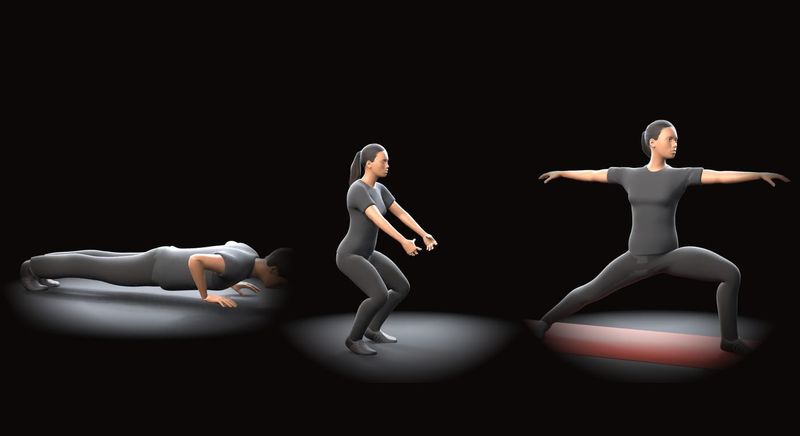
The Trainaq Exercise Video Library is a one-time download of Trainaq's own 3D exercise demonstrations: short, silent loops of an animated athlete on a dark backdrop, made to sit beside a workout step in an app or on a web page. You can watch real preview clips and compare the plans before you buy.
| Plan | Exercises and videos | Price in India | Price outside India |
|---|---|---|---|
| Male workout videos | 563 exercises, 725 videos | ₹24,999 + GST, one-time | $299, one-time |
| Male + Female + Yoga + Pilates | 623 exercises, 1,604 videos | ₹44,999 + GST, one-time | $499, one-time |
| What is included | Detail |
|---|---|
| Video format | MP4 (H.264), silent loops that play in every browser and on iPhone and Android |
| Sizes | Every clip at 1080 × 1080 and 720 × 720 pixels |
| Length | 2 to 30 seconds, most clips 3 to 6 seconds |
| Versions | Male and female versions of every exercise in the complete plan |
| Yoga and Pilates | 35 yoga poses and 25 Pilates exercises in the complete plan |
| Data file | JSON and CSV, one row per video |
| Updates | New and improved videos for your plan for 12 months |
The data file is what turns a folder of videos into an exercise library your app can search. Each row carries the exercise and video ids, the name, body part, target and secondary muscles, equipment, category, level, numbered instructions, gender, camera view, size, the file name inside the ZIP and the loop's length. Because each row's file name matches its MP4, your app can pair every record with its clip and filter by muscle, equipment or level.
The licence is written for gym software and fitness apps. It is lifetime and covers one company: use the videos and the data in all of that company's apps, websites and software, including paid apps for your members and clients, with no credit line. It excludes reselling or sharing the files as a library, sublicensing them to another company and using them to train AI or machine-learning models.
Example: three years of an exercise API against a one-time library
The figures in this example are illustrative: replace the monthly price with the plan your app would actually need. Both columns are before GST.
| | Exercise API at ₹2,500 a month (illustrative) | Exercise API at ₹6,500 a month (illustrative) | Trainaq complete plan |
|---|---|---|---|
| After 12 months | ₹30,000 | ₹78,000 | ₹44,999, paid once |
| After 24 months | ₹60,000 | ₹1,56,000 | ₹44,999, nothing more |
| After 36 months | ₹90,000 | ₹2,34,000 | ₹44,999, nothing more |
| Months until the API costs more | 18 | 7 | — |
The pattern holds at any price: an API keeps charging for as long as your app shows exercises, while the library's cost stops on the day you buy it. The busier your app and the higher the quota tier you need, the sooner the one-time library comes out ahead, and every month after that is money your gym keeps.
Checklist: how to choose exercise videos for your gym app
Use these questions with any exercise video source, API or download, before you commit:
The Trainaq library answers every one of these in your favour: one payment, no quota, your own hosting, offline playback, both versions, a full data file, a commercial licence for life and a free demo to test.
How to add the Trainaq exercise videos to your gym app or website
data.json or data.csv into your database, one row per video, keyed by video_id.muted, loop and playsinline.FAQs
Is an exercise video library cheaper than an exercise API?
Over time, yes for most gym apps. An exercise API charges every month for as long as your app uses it, while the Trainaq Exercise Video Library is a one-time payment per plan with a lifetime licence. The worked example above shows where the two meet at your own plan price.
Can I use the Trainaq exercise videos in a paid gym app?
Yes. The Trainaq licence covers every app, website and software product of one company, including paid apps for members and clients, with no credit line. It excludes reselling or sharing the files as a library, sublicensing and training AI models.
Do the Trainaq exercise videos work offline?
Yes. You receive the MP4 files, so you can bundle them inside your app or cache them on the device, and members can follow a workout without a connection.
Can I try the exercise videos before buying?
Yes. Trainaq emails a free demo of 10 videos, five male and five female, in both sizes, with a sample data file in the same format as the full library.
Who makes the Trainaq Exercise Video Library?
Trainaq is a brand of MyGymDesk Technologies Private Limited, the company behind MyGymDesk, and the videos are Trainaq's own 3D animations. The purchase, invoice and downloads all run on trainaq.com.
How MyGymDesk helps
The Trainaq Exercise Video Library comes from the team behind MyGymDesk, and you can see the plans and real preview clips on one page. If you also run a gym, MyGymDesk gym management software brings members, classes, payments, WhatsApp reminders and trainer-reviewed workout and diet plan drafts into one place, with a Business app and a Member app on the App Store and Google Play. Book a demo to see it with your own gym's setup.