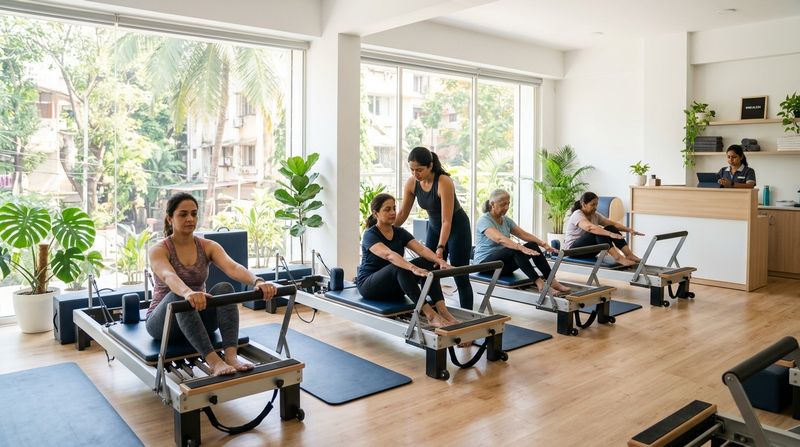
Growing a Pilates studio franchise from one location to three is not a copy-paste exercise. The first studio succeeds because you are present every day: you approve equipment purchases, you know every instructor personally and you catch booking chaos before it becomes a refund conversation. By the third location, none of that is possible in person. The business either runs on systems or it runs on stress. This post covers the four things that change most sharply — equipment standards, instructor supply, booking rules and cross-studio memberships — and how to get ahead of each one before you sign a third lease.
Before you get there, it helps to have read how to manage multiple gym branches and the Pilates studio management complete guide, which lay out the single-location foundations you need to replicate.
What Makes Reformer Equipment a Franchise-Level Problem?
At one studio you choose the reformer brand you trust, maintain it the way the manufacturer recommends, and everyone knows the quirks of every machine. At three locations, equipment inconsistency becomes a member experience problem — and a safety one.
A member who trains at your flagship and then visits your second studio will notice immediately if the carriage resistance feels different, the footbar notches sit at different heights, or the reformer brand is entirely different. That gap erodes the brand promise of a franchise.
What to standardise before location two:
Use the gym equipment cost calculator to model the capital outlay across locations before you commit to a third site — reformers, Cadillac tables, barrels and chairs add up quickly when multiplied by floor plans.
How Instructor Supply Breaks Down After One Location
Instructor supply is the most fragile part of a Pilates studio franchise in India. Qualified Pilates instructors — particularly those certified on reformer — are still relatively scarce compared to general fitness trainers. At one studio you can fill a gap with personal cover. At three, you cannot.
The problems that appear at scale:
What to put in place:
For more on the commission tracking problem, see trainer commission tracking: fixing a costly gym problem.
What Booking Rules Must Change When You Have Three Studios?
A single-studio booking policy is loose by necessity — you know members by name, you make exceptions, and the fallout from a no-show is small. At three studios with shared instructors and capped reformer classes, loose rules cost real money.
Participant Limits and Waitlists
Reformer classes are capped by the number of machines. That limit is physical, not a preference. A studio with twelve reformers cannot accommodate a thirteenth member, and overbooking causes safety issues and member complaints. Every class must have a hard participant cap, and a waitlist should activate automatically when it fills. The first person on the waitlist should move in the moment a cancellation is confirmed — not when a manager notices a gap.
Cancellation Windows
Without a cancellation window, members hold a spot until an hour before class, blocking others who wanted to attend. A standard approach: set a minimum cancellation notice period (commonly twelve to twenty-four hours) after which a late cancellation or no-show costs the member a class credit. This is not a punitive fee — it is a fairness mechanism that protects committed members on the waitlist.
Cross-Studio Booking Rights
Members who pay for one location and try to book at another will do so — especially if you market yourself as a franchise. Decide the policy before it becomes a complaint:
Whatever you choose, make it written policy, display it clearly on your self-serve sign-up page and brief every front-desk staff member.
For a deeper look at fixing overbooking in group classes, the post on how Indian gyms can fix overbooking in group classes is worth reading alongside your booking policy work.
How Cross-Studio Members Change Your Member Management
The moment a member can attend more than one location, your member record must travel with them. If Location A has a spreadsheet and Location B has a different one, you have no single view of that member's attendance, outstanding dues, freeze history or class credits. This creates:
The fix is one system that spans all locations, with staff access limited to their branch and owner-level access that sees everything. That means a Location B instructor cannot see Location A's revenue — but you can see both from a single dashboard.
Example: Cross-Studio Membership in Practice
These figures are illustrative.
| Scenario | Single-location system | Multi-location system |
|---|---|---|
| Member freezes at Location A, visits Location B | No alert; member admitted | System flags invalid membership; front desk can act |
| Instructor covers both Location A and B | Commission tracked in two spreadsheets; errors likely | Commissions generated from both location timetables automatically |
| Owner reviews monthly performance | Exports from two systems, manual merge | All-Locations view; revenue, attendance, dues by branch in one table |
Checklist: Systems to Have Before Opening Location Three
How MyGymDesk Helps
MyGymDesk's franchise management software gives Pilates studio chains a single login for every location, a Location Performance table that compares revenue, member growth, attendance, retention and dues by branch, and staff access that stays limited to each person's own studio. Class participant limits, automatic waitlists, cancellation windows and class commission tracking are built in — so the booking rules you set at Location One carry forward consistently to Location Three. Book a demo to see how it works for a reformer studio chain.
FAQs
What is the biggest operational risk when opening a second Pilates studio?
Instructor supply is the most common pressure point. Qualified reformer Pilates instructors are not easy to find in most Indian cities, and opening a second location without a committed lead instructor in place is the fastest way to damage both studios' quality and reputation.
Should a Pilates franchise charge the same membership price at every location?
Not necessarily. Rent, equipment costs and local demand vary by area. A franchise can set a price band — a minimum and maximum — and let each location price within it. What should stay consistent is the membership structure: what is included, what the freeze policy is and how cross-studio access works.
How do you handle a member who wants to attend classes at multiple Pilates studios in your chain?
The cleanest approach is a defined all-access or multi-location membership tier at a premium price. This avoids ad-hoc exceptions that are hard to track. The tier should be set up in your management software so the member's booking rights are enforced automatically at each location, rather than relying on staff recognition.
When does a Pilates studio franchise need GST registration?
GST registration is required above ₹20 lakh aggregate turnover across all locations (₹10 lakh in special category States), per the GST Council. When your chain crosses that threshold, all studios are invoicing under the same registration. Confirm the exact obligation and filing structure with a chartered accountant, particularly for a franchise model where each location may operate under a separate entity.
What booking software features matter most for a reformer studio chain?
Hard participant caps per class, automatic waitlists, a defined cancellation window, and cross-location booking rights that the system enforces rather than staff remembering. You also want class commission tracking that works across all locations, so instructors who cover multiple studios are compensated accurately each month. See class booking software for what to look for.