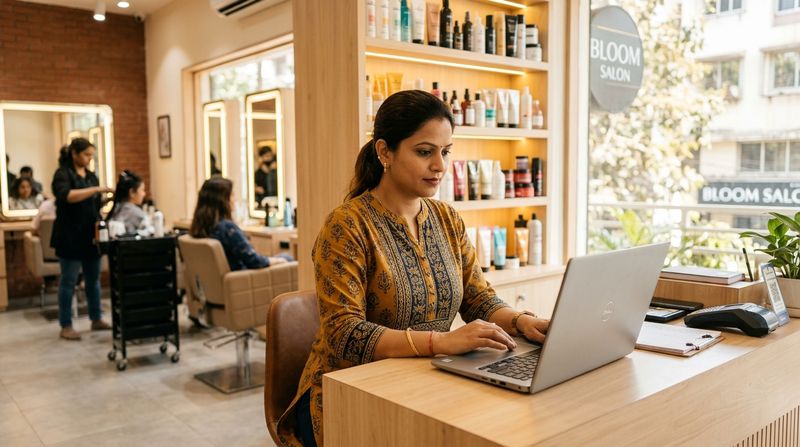
It is the last Sunday of the month. Your senior stylist is asking why her commission looks lower than last month even though she did more services. Your spa therapist wants to know if his PF has been deducted correctly. And you are sitting with a spreadsheet that has seventeen columns, three hidden formula errors, and a tab simply titled "DO NOT TOUCH." Sound familiar?
If you run a salon or spa in India with anywhere between eight and twenty staff, payroll is probably the most time-consuming, argument-inducing task in your business calendar. The problem is not that you are disorganised — it is that generic payroll tools were simply not built for the way your business works. A base salary combined with per-service commission, retail product targets, variable attendance, and statutory deductions like PF and ESI is a payroll structure that breaks most off-the-shelf HR software within the first month.
This buyer's guide cuts through the noise. We will walk through every option a salon or spa owner in India realistically considers in 2026, explain where each one falls short, and show you what a purpose-built payroll solution actually looks like. If you have been putting off fixing your payroll process, this is the post that will help you make a decision.
Why Salon & Spa Payroll Is Uniquely Complicated
Most payroll guides are written for offices where everyone earns a fixed monthly salary, works standard hours, and has no commission component. Your business is nothing like that.
A typical mid-size salon or spa in India has:
When you try to manage all of this in a spreadsheet, you are essentially rebuilding payroll software from scratch every single month — manually, with no audit trail, and with the very real risk of calculation errors that create compliance exposure.
The stakes are not trivial. A missed PF remittance or an incorrect ESI deduction can result in penalties from the EPFO and ESIC. If you are unsure how these obligations work, the guide to PF & ESI compliance for Indian businesses breaks down the thresholds and remittance timelines in plain language — it is worth reading even if you are not in the fitness industry, since the statutory rules apply identically to salons and spas.
Option 1: Outsourcing to Your CA
Many salon owners in India hand their payroll to their chartered accountant. This feels like the safe, hands-off choice — and for very small teams, it can work. But as your team grows past eight people, the arrangement starts to show cracks.
The problems:
Outsourcing to your CA is not wrong. It is just slow, expensive for what it delivers, and heavily dependent on your own ability to compile accurate input data — which brings you right back to the spreadsheet problem.
Option 2: Excel and Google Sheets
Excel is where most salon payroll lives, and for good reason — it is flexible, familiar, and free. A skilled person can build a surprisingly capable payroll sheet in Excel. The problem is that "skilled person" is usually you, it takes hours to maintain, and one formula error can cascade across an entire month's calculations without you realising it.
Specific pain points with Excel-based salon payroll:
The broader pattern of why businesses struggle to move away from spreadsheets — even when they know they should — is explored in detail in why Indian businesses struggle to move from Excel to software. The emotional anchors and practical inertia described there apply just as strongly to salon owners as to any other business.
Option 3: Generic HR and Payroll Apps (Zoho Payroll, Keka, Etc.)
India's HR software market has grown significantly, and tools like Zoho Payroll, Keka, and GreytHR are genuinely good products — for businesses they were designed for. A technology company with 50 salaried employees, fixed working hours, and no commission structure will find these tools excellent.
For a salon or spa, the fit is much weaker.
Where generic HR apps fall short for salons:
None of this means these tools are bad. It means they are solving a different problem than the one you have.
What Purpose-Built Salon Payroll Software Should Do
Before comparing further, it is worth being explicit about what good payroll software for salons and spas in India actually needs to deliver in 2026:
This is not a wishlist. These are table-stakes features for any salon or spa paying staff on a mixed compensation structure.
Option 4: MGD Payroll — Built for Commission-Based Teams
MGD Payroll is the payroll module within the MyGymDesk platform, and while the platform was originally built for fitness businesses, the payroll engine is designed specifically around commission-based, attendance-driven teams — which describes your salon or spa exactly.
Here is how it addresses the specific problems outlined above:
Attendance feeds directly into salary. If your salon uses a biometric device or QR-based check-in, attendance data flows directly into the payroll calculation. You do not re-enter it. You do not compile a report and email it to anyone. The system knows who was present, for how long, and on which days — and it uses that data to calculate the payable salary automatically.
Per-service commissions are calculated at the transaction level. When a stylist completes a service, the commission is logged at that point. At month end, the system aggregates all service commissions per staff member. There is no separate spreadsheet, no manual totalling, no disputes about which services were counted.
Tiered slab support is built in. You configure your commission structure once — for example, 10% on service revenue up to ₹30,000 and 15% on revenue above that — and the system applies it automatically every month. Changing the slab for a promoted employee takes under two minutes.
PF and ESI are handled per employee threshold. The system knows which employees fall above and below the PF wage ceiling (currently ₹15,000 per month for PF and ₹21,000 for ESI). It applies the correct deduction rates to each individual, not a blanket rule. This is the kind of nuance that generic tools either ignore or push back to you as a manual configuration task.
Payslips land on staff WhatsApp automatically. Once you run payroll, each staff member receives their payslip via WhatsApp — no printing, no distribution, no queue at the front desk on salary day. Staff can refer back to their payslip at any time without calling you. This alone eliminates a meaningful chunk of the end-of-month admin.
Advance salary and loans are tracked within the system. If a therapist asks for a ₹5,000 advance on the 15th, you log it once. The system deducts it from their next payslip automatically. No sticky notes, no risk of forgetting.
For salon owners who also want to track staff productivity — which services each team member is completing, and how that translates to commission — the approach mirrors what is described in how to track trainer commissions effectively, which covers the commission tracking logic in detail.
The Real Cost of Getting Payroll Wrong
The hidden cost of a broken payroll process is not just the hours you spend on it. It is the compounding effect on your business:
Actionable Steps to Fix Your Salon Payroll This Month
You do not need to overhaul everything at once. Here is a practical sequence:
Choosing the Right Payroll Software: A Quick Decision Guide
| Your Situation | Best Option |
|---|---|
| Fewer than 5 staff, all on fixed salary | CA or Excel |
| 5–8 staff, simple structure | Zoho Payroll or similar generic tool |
| 8–20 staff, base + commission + PF/ESI | MGD Payroll |
| Multiple locations, complex commission | MGD Payroll with a demo walkthrough |
If your team falls in the 8–20 staff bracket with a mixed compensation structure, generic tools will frustrate you and a CA will slow you down. Purpose-built commission payroll software is the right fit — and it pays for itself quickly in time saved and disputes avoided.
Conclusion: Your Last Sunday of the Month Should Be Easier
Running a salon or spa in India is genuinely hard work. Your payroll process should not add to that difficulty. The combination of base salary, per-service commission, retail targets, PF, ESI, and variable attendance is complex — but it is a solved problem once you have the right tool.
If you are still fighting your spreadsheet at the end of every month, it is worth spending 30 minutes to see whether there is a better way. Book an MGD Payroll demo and walk through a real payroll run with your actual staff structure. Ask the hard questions — about commission slabs, PF thresholds, WhatsApp payslip delivery, mid-month joiners. You will know within that call whether it fits your business.
Your stylists and therapists work hard for their commissions. They deserve to receive the right amount, on time, with a payslip they can actually read — every single month.